A data structure is a way of organizing, managing, and storing data in a computer so that it can be accessed and modified efficiently. It defines the relationships between data and how they can be operated on. Data structures are essential for writing efficient algorithms and handling large amounts of data.
There are various types of data structures, each suited for different kinds of operations and applications.
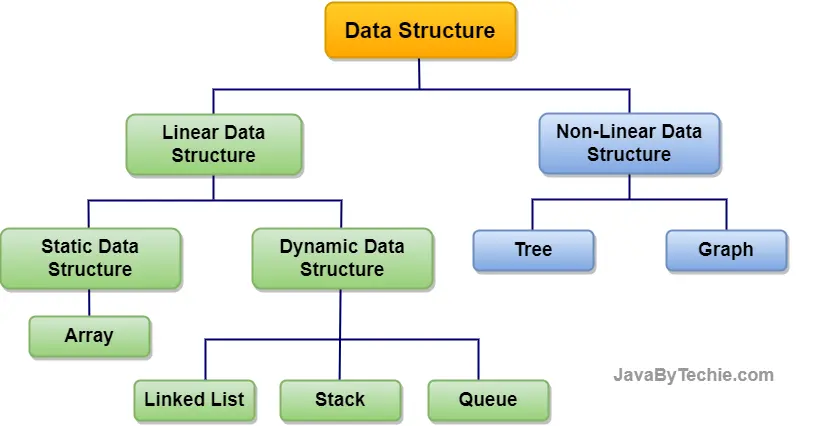
Data structure is mainly classified into two categories:
- Linear Data Structure
- Non-Linear Data Structure
What is Linear data structure?
A linear data structure arranges data elements sequentially or linearly, connecting each element to its preceding and subsequent adjacent elements.
Examples of linear data structures are Arrays, Stacks, Queues, Linked Lists, etc.
Linear data structures are further divided into two distinct categories: static and dynamic data structures.
Static Data Structure: A static data structure has a fixed memory size. The elements of a static data structure are simpler to retrieve. An example of a static data structure is an array.
Dynamic Data Structure: In a dynamic data structure, the memory size is not fixed; it can be changed during the runtime, which may be considered efficient concerning the memory (space) complexity of the code. Examples of dynamic data structures include linked lists, stacks, and queues. These structures provides flexible memory allocation, enabling efficient use of resources as the program runs and data needs change.
What is Non-Linear Data Structure?
Non-linear data structures are not arranged sequentially or linearly. Instead, elements are organized in a hierarchical or interconnected manner, forming complex relationships between elements.
Non-linear data structures offer greater flexibility and efficiency for organizing relationships and hierarchical data.
Trees and Graphs are the popular examples of non-linear data structures.
Difference between Linear and Non-linear Data Structures
| Characteristic | Linear Data Structure | Non-Linear Data Structure |
|---|---|---|
| Arrangement of Data Elements | A linear data structure arranges data elements sequentially or linearly, connecting each element to its previous and next adjacent elements. | Data elements are organized in a hierarchical or interconnected manner. |
| Applications | Simple data storage, task scheduling, function call management. | Complex data representation like organizational hierarchies, social networks, network routing. |
| Memory Utilization | Linear data structures can't utilize memory very efficiently. | It uses memory very efficiently. |
| Traversal | In linear data structure, data elements can be traversed in a single run only. | While in non-linear data structure, data elements can't be traversed in a single run only. |
| Parent-Child Relationship | Each element (except first and last) has a single predecessor and successor. | Nodes can have multiple children and parents (in graphs). |
| Advantages | Simple implementation makes it easier to understand and work with. | Efficient for hierarchical and networked data and supports complex relationships. |
| Disadvantages | It can be inefficient for certain operation and has limitations when it comes to representing complex relationships. | More complex to implement, can require more memory and management. |
| Examples | Examples of linear data structures are Arrays, Stacks, Queues, Linked Lists, etc. | Trees and Graphs are the popular examples of non-linear data structures. |
| Example Use Cases |
|
|