break Statement in Java – Explained with Examples
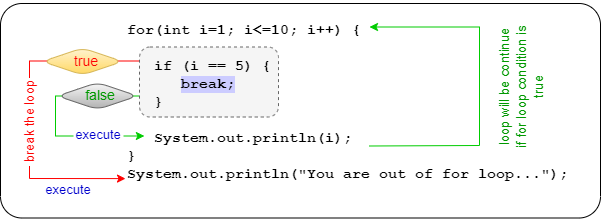
The break statement stops a loop or a switch immediately and continues with the code after it. It is how you say "I have what I need, stop now": stop searching once an item is found, stop reading when the data ends, or leave a switch after the matching case.
This tutorial shows break in every kind of loop, explains labeled break for nested loops, covers break in switch, and compares it with continue and return.
1. What Does break Do?
- Inside a loop (
for,while,do-while, for-each),breakends the innermost loop at once. The loop's condition and update are not evaluated again. - Inside a classic
switch,breakends theswitchand prevents fall-through. - With a label,
break label;ends the labeled statement, typically an outer loop.
2. break in for, while and do-while Loops
public class BreakInLoops {
    public static void main(String[] args) {
        // for: stop searching once the item is found
        String[] shelf = {"pen", "notebook", "stapler", "glue", "tape"};
        for (int i = 0; i < shelf.length; i++) {
            System.out.println("checking " + shelf[i]);
            if (shelf[i].equals("stapler")) {
                System.out.println("found stapler at index " + i);
                break;                       // the remaining items are never checked
            }
        }

        // while: first number divisible by both 6 and 14
        int n = 1;
        while (true) {
            if (n % 6 == 0 && n % 14 == 0) break;
            n++;
        }
        System.out.println("smallest common multiple of 6 and 14: " + n);

        // do-while: stop when the running total passes 50
        int total = 0, day = 0;
        int[] sales = {12, 18, 9, 15, 20, 11};
        do {
            total += sales[day];
            day++;
            if (total > 50) break;
        } while (day < sales.length);
        System.out.println("target passed on day " + day + " with total " + total);
    }
}checking pen checking notebook checking stapler found stapler at index 2 smallest common multiple of 6 and 14: 42 target passed on day 4 with total 54
In each loop, break skipped all remaining iterations as soon as the goal was reached. In the while (true) loop, break is the only way out, a common pattern when the exit test fits best in the middle of the body.
3. Labeled break for Nested Loops
A plain break exits only the loop it is in. To leave several nested loops at once, put a label (an identifier followed by a colon) before the outer loop and write break label;:
public class LabeledBreak {
    public static void main(String[] args) {
        int[][] seats = {
                {1, 1, 0, 1},
                {1, 1, 1, 1},
                {0, 1, 1, 0}
        };   // 1 = booked, 0 = free

        int freeRow = -1, freeCol = -1;
        search:                                   // label for the outer loop
        for (int r = 0; r < seats.length; r++) {
            for (int c = 0; c < seats[r].length; c++) {
                if (seats[r][c] == 0) {
                    freeRow = r;
                    freeCol = c;
                    break search;                 // exits BOTH loops
                }
            }
        }
        System.out.println("first free seat: row " + freeRow + ", column " + freeCol);

        // Without a label, break only leaves the inner loop
        for (int r = 0; r < seats.length; r++) {
            for (int c = 0; c < seats[r].length; c++) {
                if (seats[r][c] == 0) {
                    System.out.println("row " + r + ": first free column " + c);
                    break;                        // continues with the next row
                }
            }
        }
    }
}first free seat: row 0, column 2 row 0: first free column 2 row 2: first free column 0
With break search;, both loops ended at the first free seat. The plain break in the second version only left the inner loop, so the outer loop moved on to the next row.
return is often clearer.4. break in a switch Statement
In a classic switch (with case X: labels), break ends the switch. Without it, execution falls through into the next case. Inside a loop, that break leaves only the switch, not the loop:
public class BreakInSwitch {
    public static void main(String[] args) {
        String command = "stop";
        switch (command) {
            case "start":
                System.out.println("Starting...");
                break;                       // without break, "stop" would also run
            case "stop":
                System.out.println("Stopping...");
                break;
            default:
                System.out.println("Unknown command");
        }

        // Inside a loop, break in a classic switch exits the switch, not the loop
        for (int i = 1; i <= 3; i++) {
            switch (i) {
                case 2:
                    System.out.println("i = 2 (break leaves only the switch)");
                    break;
                default:
                    System.out.println("i = " + i);
            }
        }
    }
}Stopping... i = 1 i = 2 (break leaves only the switch) i = 3
Modern arrow cases (case X ->) never fall through, so they do not need break. See switch Statement.
5. break vs continue vs return
| Statement | Effect | Use it to… |
|---|---|---|
break | Exits the innermost loop or switch (or a labeled statement) | Stop looping once a goal is reached |
| continue | Skips the rest of the current iteration | Ignore certain items but keep looping |
| return | Exits the whole method | Return a result as soon as it is known |
6. Rules and Notes
- An unlabeled
breakcan only appear inside a loop orswitch; elsewhere it is a compile error ("break outside switch or loop"). - A labeled
breakcan exit any labeled block, but in practice labels are used with loops. - Statements directly after
breakin the same block are unreachable and cause a compile error. breakcannot be used inside a lambda to stopforEach(); use a regular loop or a stream method such asanyMatch()ortakeWhile().- If
breakleaves atryblock, itsfinallyblock still runs.
7. Best Practices
- Use
breakto make searches efficient: stop as soon as the answer is found. - Keep the exit condition easy to see; many hidden breaks in one loop are hard to follow.
- Prefer a clear loop condition when it expresses the end naturally.
- Use
returnfrom a helper method instead of complex labeled breaks.
8. Summary
breakimmediately exits the innermost loop orswitch.break label;exits an outer labeled loop.- In classic switch statements,
breakprevents fall-through. continueskips one iteration;returnleaves the method.
Related Tutorials
Reference: Oracle Java Tutorials: Branching Statements
Frequently Asked Questions (FAQ)
Q1. What is the break statement in Java?
A statement that immediately ends the innermost loop or switch it is in. Execution continues with the first statement after that loop or switch.
Q2. Does break exit all nested loops?
No, only the innermost one. Use a labeled break (break outer;) to exit an outer loop, or return from a method.
Q3. What is a labeled break?
A break followed by a label name. It ends the statement marked with that label, usually an outer loop: outer: for (...) { for (...) { break outer; } }.
Q4. Can break be used outside a loop?
An unlabeled break cannot; it must be inside a loop or switch. A labeled break can exit any labeled block, though this is rarely used.
Q5. Why is break needed in a switch statement?
In a classic switch, cases fall through: after a matching case runs, the following cases run too unless break stops them. Arrow-style cases do not fall through and need no break.
Q6. What is the difference between break and continue?
break ends the whole loop. continue ends only the current iteration and moves on to the next one.
Q7. What is the difference between break and return?
break exits a loop or switch but stays in the method. return exits the entire method, optionally returning a value.
Q8. Does break inside a switch exit the surrounding loop?
No. In a classic switch, break exits only the switch. To leave the loop from inside the switch, use a labeled break or restructure with arrow cases and a flag.
Q9. Can I use break in a for-each loop?
Yes. It stops the iteration immediately, just like in other loops.
Q10. Can I use break inside forEach() with a lambda?
No. A lambda is a separate method body, so break is not allowed there. Use a regular loop, or stream methods like anyMatch(), findFirst() or takeWhile().
Q11. Does finally run when break exits a try block?
Yes. If break leaves a try block inside a loop, the finally block runs before the loop ends.
Q12. Is using break bad practice?
No. It is the clearest way to stop a search early. Problems arise only when loops contain many breaks or deeply nested labeled breaks that hide the control flow.
Q13. Can I write code after break in the same block?
No. Such code can never run, and the compiler reports an "unreachable statement" error.
Q14. How do I exit an infinite loop?
Use break (or return) when the exit condition is met: while (true) { ...; if (done) break; }.
Q15. Can a label be placed on any statement?
Yes, but labels are only useful on loops (for break and continue) and on blocks (for break). Label names follow identifier rules and are usually short words like outer or search.
Q16. Does Java have goto instead of labeled break?
No. goto is reserved but unusable. Labeled break and continue provide the structured jumps that Java allows.
Q17. What happens to the loop variable after break?
It keeps the value it had when break ran. If the variable was declared before the loop, you can use that value afterwards, for example as the index where an item was found.
Q18. Do I need break in a switch expression?
No. Switch expressions use arrow cases or yield; break cannot be used to leave a switch expression.
Q19. Can break improve performance?
Yes, when it avoids unnecessary iterations, for example stopping a linear search as soon as the item is found instead of checking the rest of a large array.
Q20. How do I break out of a loop based on user input?
Read the input inside the loop and break when it matches the exit value: if (line.equals("quit")) break;.